


 Cart
Cart
 sales@molnova.com


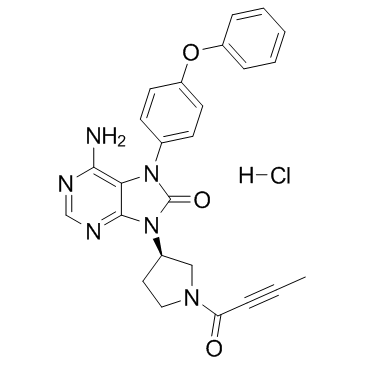
ONO-4059 hydrochloride
CAS No. 1439901-97-9
ONO-4059 hydrochloride( ONO4059 hydrochloride | Tirabrutinib hydrochloride | GS4059 hydrochloride )
Catalog No. M11864 CAS No. 1439901-97-9
A potent, selective, third-generation irreversible inhibitor of mutant EGFR.
Purity : >98% (HPLC)
 COA
Datasheet
HNMR
HPLC
MSDS
Handing Instructions
COA
Datasheet
HNMR
HPLC
MSDS
Handing Instructions
| Size | Price / USD | Stock | Quantity |
| 5MG | 39 | Get Quote |


|
| 10MG | 69 | Get Quote |
|
| 25MG | 113 | Get Quote |
|
| 50MG | 186 | Get Quote |
|
| 100MG | 332 | Get Quote |
|
| 200MG | Get Quote | Get Quote |
|
| 500MG | Get Quote | Get Quote |
|
| 1G | Get Quote | Get Quote |
|
Biological Information
-
Product NameONO-4059 hydrochloride
-
NoteResearch use only, not for human use.
-
Brief DescriptionA potent, selective, third-generation irreversible inhibitor of mutant EGFR.
-
DescriptionA potent, selective, third-generation irreversible inhibitor of mutant EGFR with IC50s of 1/12/5 nM for L858R-T790M/L858R/L861Q respectively; weak activity against wt EGFR (IC50=184 nM); inhibits signaling pathways and cellular growth in both EGFRm(+) and EGFRm(+)/T790M(+) mutant cell lines in vitro; exhibits tumor regression in EGFR-mutant tumor xenograft and transgenic models; orally active.Blood Cancer Phase 3 Clinical.
-
In VitroTirabrutinib hydrochloride (0.1-1000 nM or 0.001-100 nM; 72 h) inhibits the proliferation of OCI-L Y10 and SU-DHL-6 cells with IC50s of 9.127 nM, and 17.10 nM, respectively.Tirabrutinib hydrochloride (0.5, 5, 50 μM; 24, 48 h) induces SU-DHL-6 cells apoptosis needs high dosage and prolonged administration (concentration up to 50 μM and incubates for 48 h).Tirabrutinib hydrochloride (300 nM, 72 h) induces caspase-3 and PARP cleavage in TMD8 cells. Cell Proliferation Assay Cell Line:SU-DHL-6 and OCI-L Y10 cells Concentration:0.1-1000 nM; 0.001 nM-100 nM.Incubation Time:72 h Result:Showed good anti-proliferative activity with IC50s of 9.127 nM, and 17.10 nM for OCI-L Y10 and SU-DHL-6 cells, respectively.Apoptosis AnalysisCell Line:SU-DHL-6 cellsConcentration:0.5, 5, 50 μM Incubation Time:24, 48 h Result:Induced cell apoptosis when concentration up to 50 μM and incubated for 48 h.Western Blot AnalysisCell Line:TMD8 cells Concentration:300 nM Incubation Time:72 h Result:Induced caspase-3 and PARP cleavage.
-
In VivoTirabrutinib hydrochloride (10 mg/kg; p.o.; single) is rapidly absorbed into plasma and brain, and reaches Cmax (blood Cmax =339.53 ng/mL; brain Cmax =28.9 ng/mL) 2 hours post administration.Tirabrutinib hydrochloride (6, 20 mg/kg; p.o.; single daily for 3 weeks) shows inhibition of tumour growth in vivo. Animal Model:Male SD rats (219.0–260.5g).Animal Model:Immunodeficiency (SCID) mice (mouse xenograft model).Dosage:6, 20 mg/kg Administration:Oral administration; single daily for 3 weeks.Result:Inhibited tumour growth, and when dosage up to 20 mg/kg, a complete tumor suppression at day 14.
-
SynonymsONO4059 hydrochloride | Tirabrutinib hydrochloride | GS4059 hydrochloride
-
PathwayTyrosine Kinase
-
TargetBTK
-
RecptorBTK
-
Research AreaCancer
-
IndicationBlood cancer
Chemical Information
-
CAS Number1439901-97-9
-
Formula Weight490.9415
-
Molecular FormulaC25H23ClN6O3
-
Purity>98% (HPLC)
-
Solubility10 mM in DMSO
-
SMILESCC#CC(=O)N1CCC(C1)N2C3=NC=NC(=C3N(C2=O)C4=CC=C(C=C4)OC5=CC=CC=C5)N.Cl
-
Chemical Name8H-Purin-8-one, 6-amino-7,9-dihydro-9-[(3R)-1-(1-oxo-2-butyn-1-yl)-3-pyrrolidinyl]-7-(4-phenoxyphenyl)-, hydrochloride (1:1)
Shipping & Storage Information
-
Storage(-20℃)
-
ShippingWith Ice Pack
-
Stability≥ 2 years
Reference
1. Walter HS, et al. Blood. 2016 Jan 28;127(4):411-9.
2. Yahiaoui A, et al. PLoS One. 2017 Feb 8;12(2):e0171221.
3. Yasuhiro T, et al. Leuk Lymphoma. 2017 Mar;58(3):699-707.
molnova catalog



related products
-
QL-47
A potent, selective, and irreversible BTK inhibitor with IC50 of 7 nM.
-
Tyrosinase-IN-16
Tyrosinase-IN-16 inhibited tyrosinase.
-
Edralbrutinib
Edralbrutinib (TG-1701) is a potent BTK inhibitor with anticancer activity used in treating tumors, immune system disorders, and blood and lymphatic system disorders.
